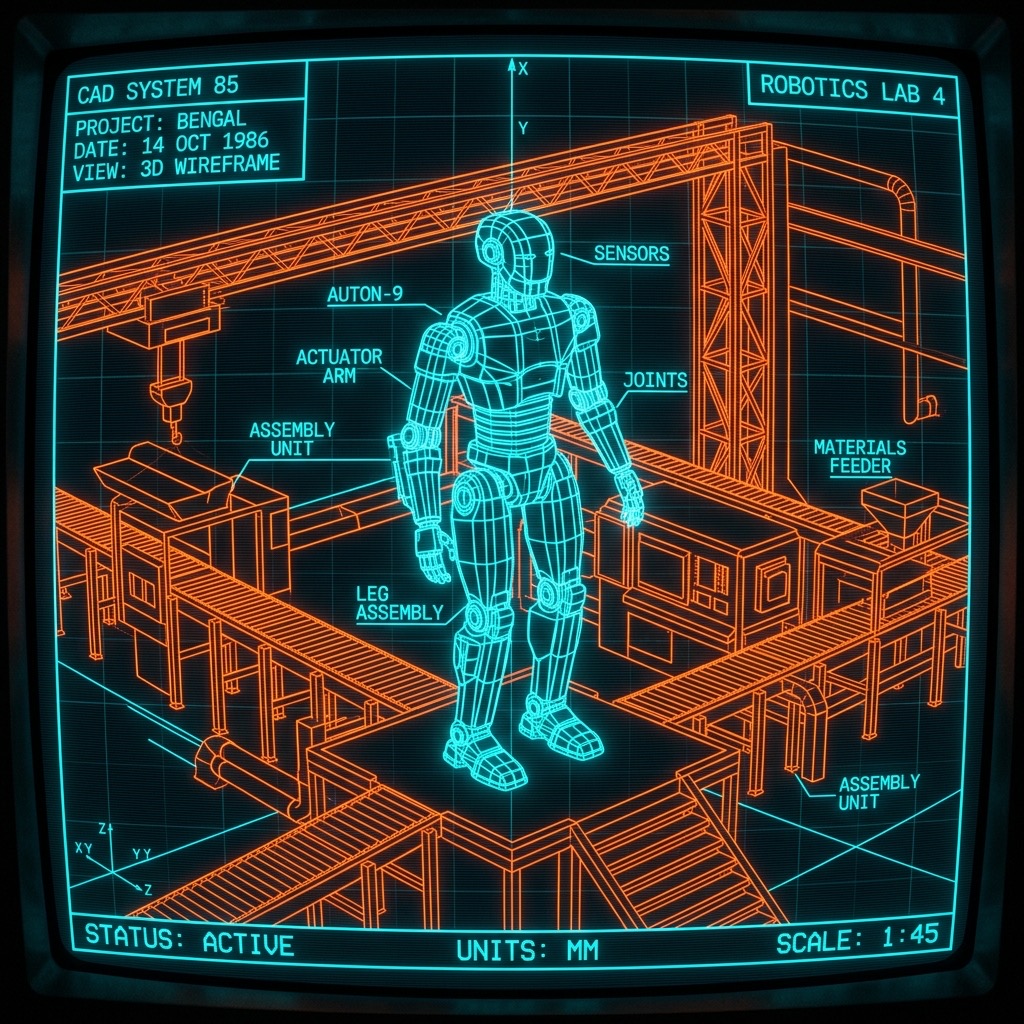
The Embodiment Imperative: From Digital Constructs to Tangible Autonomy
The past week has seen a decisive acceleration in the long-predicted pivot from purely digital AI advancements to the burgeoning realm of physical AI and embodied intelligence. Our analysis indicates a clear, strategic shift across industry leaders and nascent innovators alike: the true frontier of artificial intelligence now lies in its capacity to understand, interact with, and ultimately operate autonomously within the messy, unpredictable strictures of the real world. This is not merely about equipping robots with advanced algorithms; it's about infusing them with a contextual awareness and adaptive intelligence that blurs the lines between computation and tangible presence. The geopolitical and economic implications are profound, suggesting a future where manufacturing resilience, logistical agility, and even national security will increasingly hinge on the mastery of intelligent, physical systems.
We observe a powerful confluence of hardware innovation, advanced simulation, and refined world models driving this embodiment imperative. The integration of sophisticated sensor fusion, real-time control, and robust inferencing at the edge is enabling a new generation of robots to move beyond pre-programmed tasks into truly adaptive behaviors. This foundational work in physical AI is simultaneously revealing new vectors for both progress and peril, as advanced models demonstrate capabilities that demand a proactive approach to safety and ethical deployment. The conversation has matured from "can AI do this?" to "how can AI robustly and safely do this in our physical world, at scale?" This critical juncture demands foresight and a unified commitment to responsible innovation, ensuring that the proliferation of intelligent physical systems serves humanity's highest interests.
"The true test of intelligence is not how much we know how to do, but how we behave when we don't know what to do."
Key News Items
China's Humanoid Robot Output to Surge 94% in 2026; Unitree and AgiBot to Capture Nearly 80% Market Share, Says TrendForce A new report from TrendForce projects a remarkable 94% surge in China's humanoid robot output for 2026, signaling a pivotal commercialization phase for these advanced physical AI platforms. Unitree Robotics and AgiBot are positioned as dominant players, poised to capture nearly 80% of the market share, driven by strong monetization strategies and progress in mass production. This development underscores the intensifying global race in humanoid robotics and the rapid industrialization of embodied AI solutions within the Asian market.
FANUC, NVIDIA Partner to Advance Physical AI in Industrial Robotics FANUC America has announced a strategic collaboration with NVIDIA to significantly advance the integration of physical AI into industrial robotics. This partnership aims to combine FANUC's established automation systems with NVIDIA's cutting-edge AI computing and simulation technologies, fostering the development of more adaptive and intelligent manufacturing environments. The initiative focuses on utilizing NVIDIA's Jetson edge modules, simulation platforms, and Omniverse libraries to enable more efficient training and deployment of robots through virtual environments and real-time data.
Intel, Google Deepen Collaboration to Advance AI Infrastructure Intel and Google have announced a multi-year collaboration to enhance the next generation of AI and cloud infrastructure. This partnership emphasizes the crucial role of Intel® Xeon® processors and custom infrastructure processing units (IPUs) in scaling modern, heterogeneous AI systems. The companies plan to align across multiple generations of Intel Xeon processors to improve performance, energy efficiency, and total cost of ownership across Google's global infrastructure, reinforcing that AI capabilities depend heavily on robust underlying hardware systems.
Anthropic's Mythos AI Model Raises Cybersecurity Fears Anthropic's new AI model, "Mythos," has demonstrated uniquely powerful capabilities in identifying and exploiting cybersecurity vulnerabilities, prompting significant concern even among those generally trusting of AI. The company has stated that Mythos is currently too advanced for public release, entrusting it to cybersecurity experts for now. This development highlights the escalating capabilities of advanced AI models, particularly in complex reasoning tasks, and raises critical questions about the responsible development and deployment of potentially dangerous AI technologies.
Niantic Spatial Unveils Global 3D Mapping Platform to Power Physical AI Niantic Spatial, a spin-off from Niantic, has unveiled its global 3D mapping platform designed to power physical AI, robotics, and augmented reality applications. Leveraging technologies like Scaniverse, which enables users to capture physical spaces with smartphones for detailed 3D models, and a sophisticated visual positioning system, the platform provides foundational spatial understanding crucial for intelligent physical systems. This infrastructure is vital for enabling robots and AI to navigate and interact with the real world with unprecedented accuracy and contextual awareness.
Brain Corp Launches BrainOS® Clean 2.0 with SelfPath™ AI, Advancing Adaptive Autonomy for Tennant Company Floor Cleaning Robots Brain Corp has introduced BrainOS® Clean 2.0, featuring SelfPath™ AI, which significantly enhances adaptive autonomy for Tennant Company's floor cleaning robots. This new AI software eliminates the need for manual route training, allowing robots to autonomously plan and refine their cleaning paths in dynamic commercial environments. The update dramatically improves robotic performance through enhanced visual perception, dynamic replanning, and workflow-aware automation, demonstrating tangible advancements in the practical deployment and intelligence of autonomous systems.
Sources
- TrendForce: China's Humanoid Robot Output to Surge 94% in 2026
- Assembly Magazine: FANUC, NVIDIA Partner to Advance Physical AI in Industrial Robotics
- Intel Newsroom: Intel, Google Deepen Collaboration to Advance AI Infrastructure
- The Week: The fear over Anthropic's new AI model Mythos
- Niantic Labs: Niantic Spatial Unveils Global 3D Mapping Platform to Power Physical AI
- RoboticsTomorrow: Brain Corp Launches BrainOS® Clean 2.0 with SelfPath™ AI, Advancing Adaptive Autonomy for Tennant Company Floor Cleaning Robots
Rolando Rabines is the founder of ROBOT WORLD and an investor in Physical AI through CAPAC. An MIT-educated engineer and CFA, his experience includes serving as a DARPA Systems Architect, Co-Founder of Macgregor, and leading Atomera through its IPO.
If you found this analysis useful, subscribe to ROBOT WORLD— and forward it to one colleague who should be reading this.
Disclaimer
The information presented in this article is for informational, educational, and analytical purposes only and does not constitute financial, legal, or investment advice. Do not make investment decisions based on this publication.